



















In questo articolo
Have you ever heard of muslin cotton? It is a natural fabric that is very lightweight, known for being fresh, breathable, and highly versatile. Its origins—as we will see—are the subject of numerous legends, but it is certain that this product, initially created by weaving silk threads, gradually came to be produced with cotton.
But what exactly is it, where does it come from, and how is it processed? Let’s explore these questions together, starting with the definition and then examining its origins and most common uses.
What is muslin cotton and how does it differ from traditional cotton?
If we were to define it, muslin cotton could be described as “a soft and lightweight fabric with a weave similar to canvas” (source Treccani.it).
Although its production involves using cotton fiber, there is a significant difference between muslin and regular cotton mainly based on texture. In particular, muslin’s structure resembles organza.
Why is it called muslin cotton?
In the Fertile Crescent, on the banks of the Tigris River, lies the city of Mosul. The Iraqi city, once called Nineveh—a wealthy center of ancient Mesopotamia—gives its name to muslin.
The name muslin derives from the city of Mosul, though the fabric’s origin seems to be Bengali. It features a very open and semi-transparent weave—very similar to the gauze used to dress wounds—and originates in Dhaka, the capital of present-day Bangladesh, located in the Bay of Bengal.
Let’s explore the history, production, and use of this ancient fabric, loved by Marie Antoinette, worn by ladies across Europe in the 1800s, and still used today to make blouses, dresses, sheets, bedding, and baby products.
The history of muslin and its uses
Subject to numerous legends, muslin is extremely ancient. Marco Polo himself describes a similar fabric in The Travels (circa 1298), when, visiting the kingdom of Mosul, he recounts seeing silk and gold cloths: a very fine and lightweight fabric that almost certainly corresponds to muslin.
However, the origins of muslin cotton go back even further. It seems that as early as the 2nd century BC, in the Indus Valley, garments made from this cotton already existed and that by the 9th century, Bengali muslin was traded throughout Central Asia. Moreover, this fabric was apparently also used as a base for making Thangka, hand-painted Buddhist banners widely used in Tibet, Bhutan, and Nepal.
The earliest muslin was known as Mulmul (or Malmal) and appeared as a handwoven fabric made from the finest yarns produced from cotton grown in eastern India, along the banks of the Brahmaputra River: the "Phuti karpas" (Gossypium arboreum var. neglecta).
The “woven wind” that conquered the court of the King of France
Due to its lightness and semi-transparency, muslin was also called “woven wind.”
Between the mid-1200s and early 1300s, the Indo-Persian poet and scholar Amir Khusrau described this special type of cotton as follows:
“the fabric of Bengal,” whose weave is so fine that the body is visible through it. One could fold an entire piece of this fabric within a fingernail, yet it is large enough to cover the world when unfolded.
Centuries later, under the Mughal Dynasty (1526–1857), muslin achieved even greater renown. Handwoven, this cotton formed the basis of Jamdani, a colorful fabric decorated with gold threads whose craftsmanship was later declared Intangible Cultural Heritage of Humanity by UNESCO.
Between the 17th and 18th centuries, muslin cotton arrived in Europe, and its popularity spread, also thanks to the Queen of France, Marie Antoinette. A trendsetter with eccentric and provocative tastes, Marie Antoinette influenced fashion throughout European courts and helped introduce muslin cotton to the nobility of the time.
By then, the fabric had become an integral part of the Old Continent’s noble wardrobe, embraced by figures such as Josephine and Pauline Bonaparte. Fashion in the early 1800s was clear: young and old alike wore strictly muslin and cotton clothing, lightweight and ethereal.
It’s no coincidence that in portraits of ladies from the era—which can still be admired today—Empire-style dresses with delicate puffed sleeves and soft draping in pale or white tones stand out, tenderly caressing the body in gentle contrast with bare shoulders and uncovered necks.
Muslin cotton today
The ancient handweaving of Bengali muslin was lost over the centuries. About 200 years ago, industrial production began between the 1700s and 1800s in the United Kingdom, although today some researchers are working to revive past techniques.
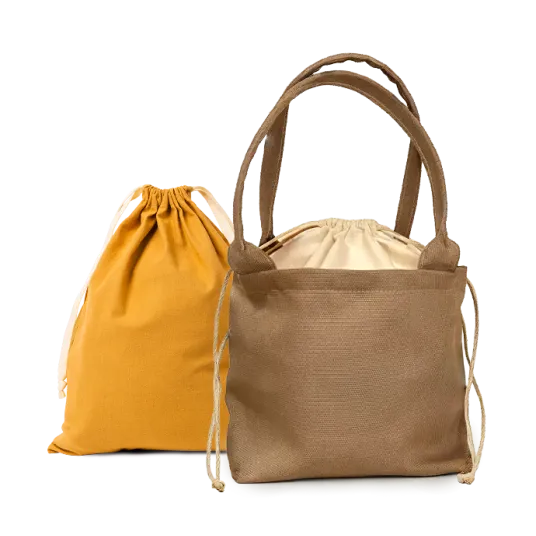
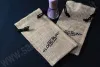
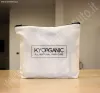
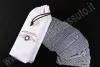
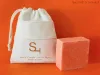
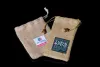
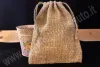
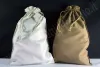
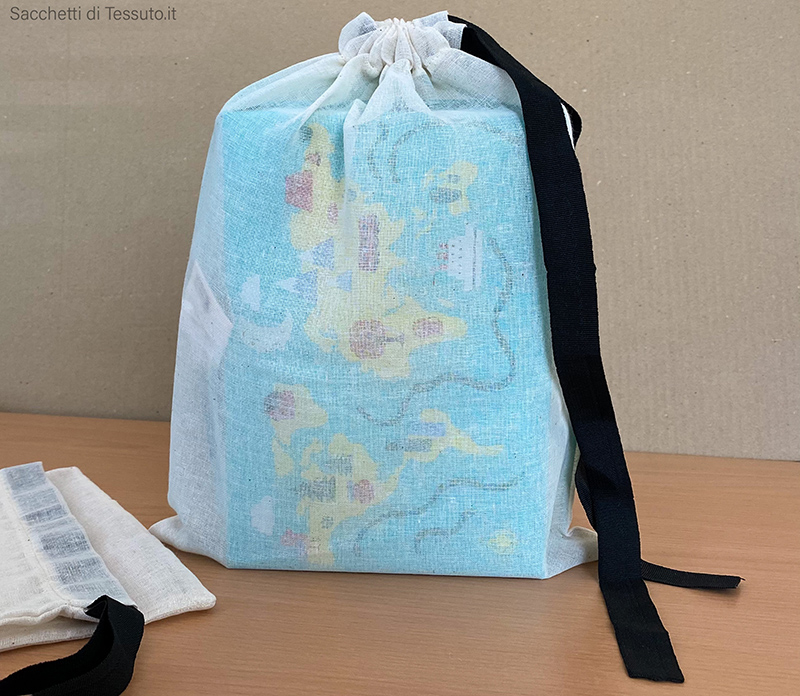
Today, muslin is found in various sectors. It is often used to make children's clothing, women's summer wear, scarves and handkerchiefs. Beyond clothing, muslin cotton is widely used for exclusive bags and packaging. All the products we make at Sacchetti di Tessuto use OEKO-TEX® certified cottons, GOTS (Global Organic Textile Standard), and EcoCert.
What are muslin swaddles for newborns?
Regarding its many uses, muslin cotton is used to produce linen, sheets, bedding, and fabrics for newborns. Being soft, absorbent, breathable, and durable, this fabric was often used by our grandmothers for baby care.
Muslin swaddles for newborns are blankets of varying sizes (70x70 cm or 120x120 cm) that can be used to wrap babies at nap time or as covers during feeding or breastfeeding.
Muslin, mull and bisse
Not only muslin cotton. There is also a lighter version on the market: mull. Mull is fine and thin, like bisse cotton. The latter is a very rare fabric and should not be confused with bisse made from the mollusk Pinna nobilis, which produces a golden fiber resembling silk. Known as “water thread” and imperceptible to the touch, the bisse harvested from this large bivalve was once used to make clothing for kings and nobles of the past!
Muslin production
Muslin fabric can be made from cotton, but also from wool, silk fibers, and blended fibers.
Although lightweight, it can be dyed, embroidered, and printed, including by screen printing. Its fabric weight ranges from 50 to 90 grams per square meter (GSM), and for a fabric to be classified as muslin, it must meet certain requirements:
- the weft threads must be finer than the warp threads;
- its density should be about 26 warp and 24 weft threads per centimeter.
What can you sew with muslin?
As we have seen, muslin can be used to create clothing and exclusive packaging products. The fabric can be sewn to make garments for children, trousers, shirts, and fashionable dresses. Some also make diapers, cushions, bibs, toys, and baby blankets. It is, therefore, a very versatile and valued product.
How do you wash muslin cotton?
Muslin is a durable fabric but, given its lightness, it must be handled with care. It can be washed by hand or machine, ensuring to not exceed 40° Celsius.
In the washing machine, spin drying is allowed, but it is advisable to keep the spin cycle as short as possible. When washing by hand, muslin should not be wrung out. It is best to avoid the tumble dryer, as it tends to dry fabrics too aggressively.
Muslin can be hung to dry but should not be exposed directly to sunlight. It can be ironed, preferably when still damp, placing a cloth between the muslin garment and the iron.
Why choose muslin over other fabrics?
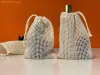
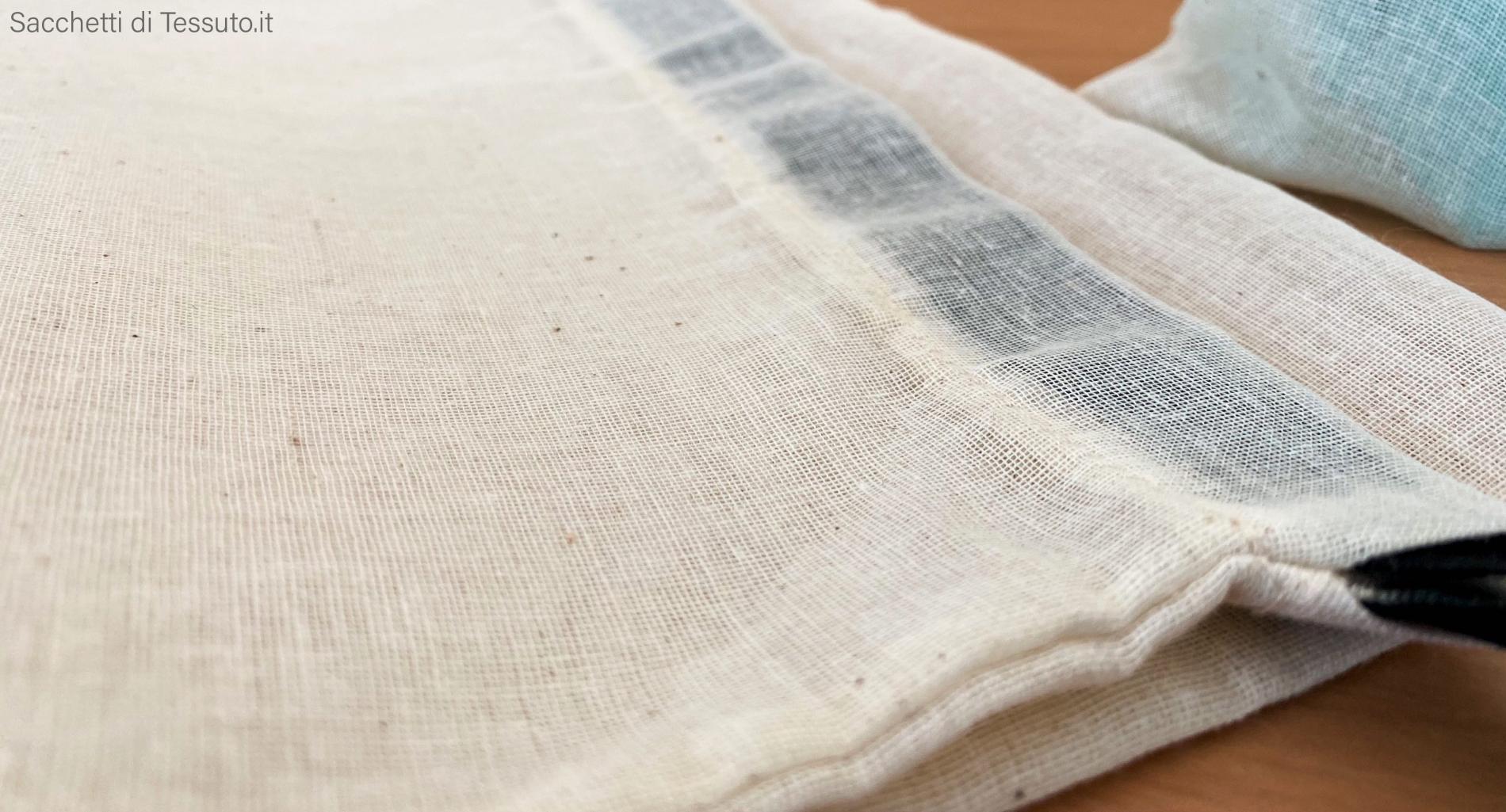
Similar to organza, which is polyester, muslin is a plant-based fabric. Both have similar structure and appearance: both organza and muslin are semi-transparent.
However, while organza is synthetic fabric, muslin is a natural fiber made from cotton. In particular, the muslin cotton bags we produce at Sacchetti di Tessuto are all certified.
A curiosity! It is said that the ancient Romans already knew muslin and called it “woven air.” It was so beloved by matrons that a legend arose that in Rome, an ounce of muslin could be sold for an ounce of gold!
Muslin bags: for which sectors are they suitable?
As we have seen, muslin is a fabric that suits many needs. Its elegance and lightness should not be misleading: muslin cotton is very durable and holds up well to weight. In commercial settings, muslin cotton bags can be used as:
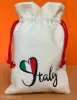
- favors for baptisms, communions, confirmations, weddings, birthdays, and other special events;
- containers for newborn clothing: a bag to hold baby clothes and accessories, a creative idea for a fashion brand or designer;
- containers for small fashion accessories: a custom muslin cotton bag is also attractive for storing small artisanal jewelry or fashion accessories such as belts and scarves;
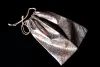
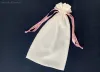
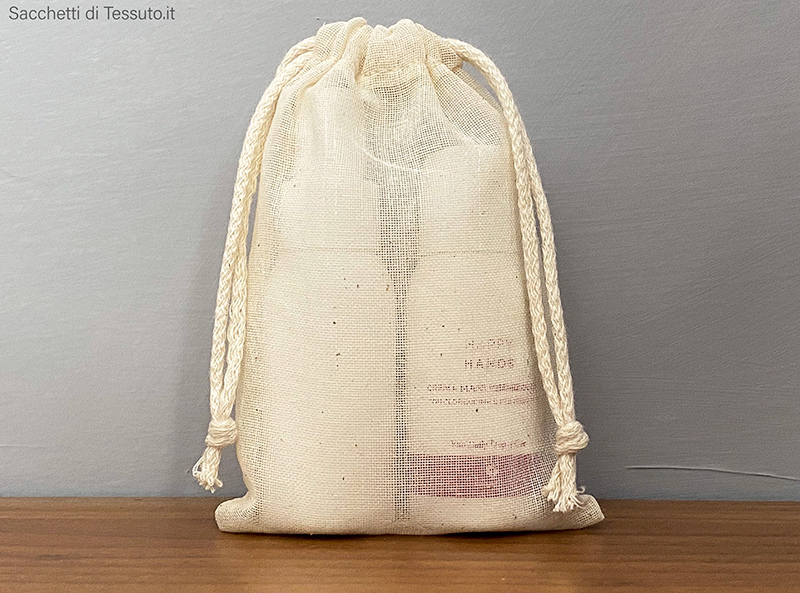
- beauty and cosmetics: muslin cotton is perfect for those seeking elegant fabric packaging that highlights the product with a semi-transparent effect, without giving up sustainability.
At Sacchetti di Tessuto, we produce fabric bags in various shapes and colors, fully customized. We select sustainable materials and prioritize small-batch production to provide you with a robust, made-to-measure product that respects the environment.
Explore our catalog!