












































In questo articolo
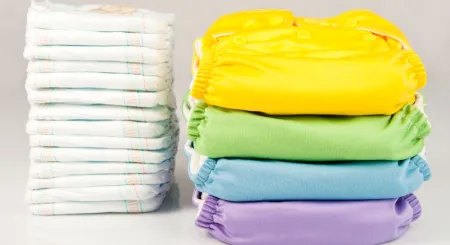
The Covid-19 emergency situation, which the whole world has been facing in recent months, has led to a increase in demand for protective masks, along with other products such as sanitizers and gloves. At this point, the waste problem arises: many masks are difficult to dispose of, they are single-use – made of polyester microfiber or polypropylene – and are often discarded into the environment.
Masks for everyone and sustainability
One of the measures under discussion in recent weeks is whether to require masks for everyone. If the Government adopts this measure, millions of single-use masks will be needed every day, which, once used, must be thrown away, causing serious environmental impacts, not to mention the economic resources required to sustain the effort.
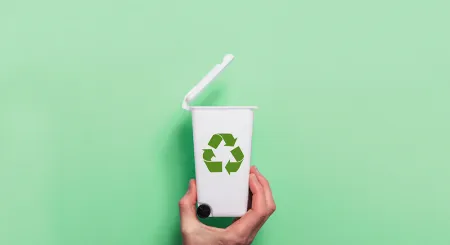
Then there is a disposal problem related to masks that can have serious repercussions on public health. The circular from the Istituto Superiore di Sanità (Iss) last March warned those in quarantine – especially people positive for Covid-19 – on how to sort waste properly. The Institute recommends placing used masks, gloves, and tissues inside the same bag or, even better, inside two or three bags to isolate the contents as much as possible. This is an indication we perhaps should all follow, since asymptomatic carriers also transmit the virus.
Therefore, the issue of how to dispose daily of millions of masks, some potentially infectious, arises, and it is legitimate to ask whether there are alternatives to disposable devices.
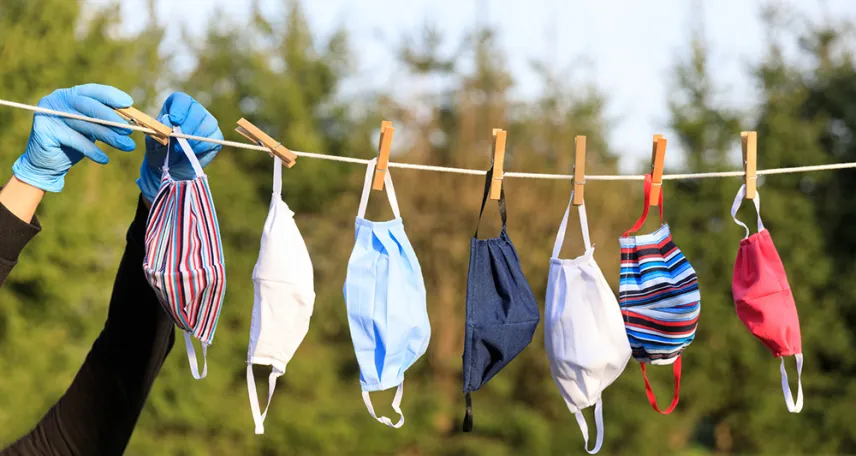
One possible solution is to use fabric masks that are washable, reusable multiple times, and consequently, less polluting.
Fabric masks can be a significant aid in ensuring that this emergency situation does not also become an environmental problem.
The demand for masks is very high and if a mandate for everyone to wear them is enforced, the demand will increase even more. Although local authorities have begun distributing masks among the population, starting with those at higher risk, supply struggles to meet demand, so much so that some pharmacies must periodically inform customers that protective masks are temporarily out of stock.
Given this scarcity, many textile companies have decided to temporarily convert their production to help.
We have decided to do the same.
Covid-19 Emergency: from fabric bags to fabric masks
We have converted part of our production, normally dedicated to manufacturing fabric bags, to produce cotton fabric masks, a material particularly suited to the need to wear personal protective equipment without harming the environment, as it is ecological and recyclable.
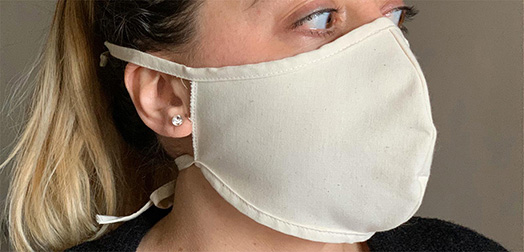
1. The masks are made of breathable, ecological, and certified cotton
The high-quality cotton masks – like those we manufacture – feature a double layer of natural cotton, are OEKO-TEX® certified, and are 100% environmentally sustainable. They are made of a lightweight, breathable, and soft fabric with high absorbency. These qualities make cotton ideal for mask production because it protects the face without making breathing difficult, as can happen with synthetic masks. Moreover, cotton is hypoallergenic, so it can be used by anyone.
2. They are washable cotton masks reusable multiple times
Cotton is a fabric particularly suitable for processing and is durable over time. You can wash the mask multiple times by hand using water and bleach or in a washing machine at up to 90°C. In contrast, disposable masks must be discarded after each use.
3. They provide filtration and are useful in many situations
Fabric masks are not FFP2 or FFP3 type and therefore do not constitute medical-surgical devices. This means they are not suitable for healthcare or workplace use. However, they can be used for personal use in many other situations – for grocery shopping, visiting the doctor, going to the newsstand, or taking a walk – especially if, like ours, they feature a very tight double layer of natural cotton and an outer layer of water-repellent cotton that filters and limits virus spread, acting as a barrier against sneezes, coughs, and saliva droplets.
How to use fabric masks
Purchasing a good protective fabric mask is not enough to protect yourself from the virus: you also need to know how to use it and store it correctly.
It is very important to use the mask only when you are about to go out. To wear it, simply place the upper strap over your ears and the lower strap at neck level, ensuring that both mouth and nose are fully covered.
When returning home, after removing gloves and washing your hands, remove the mask and disinfect it with a sanitizing spray. Wash it by hand or in the washing machine: masks can be washed like clothing or linens, as stated in point 2 of the Ministry of Health circular Questions and Answers on infection prevention and control for healthcare workers caring for patients with suspected or confirmed COVID-19.
Once washed, you can hang it up, taking care not to handle it excessively. When dry, you may iron it and store it in a dry, clean place until next use.